MILTON MOSS
ABOUT THE ARTIST
Born in New York City in 1912, Milton Moss was classically trained as a violinist and studied art at Cooper Union and Beaux Arts de Paris. He joined the army at the onset of World War II, serving as a violinist in the Army band accompanying General Omar Nelson Bradley in Europe. After the war, he stayed in France to continue studying painting, a period that proved critical in the influences Moss carried into his art over the following decades.
Moss first started showing his paintings after returning to the United States in 1961, with representation at Harbor Gallery in Long Island. Later that year, he broke into the Madison Avenue art scene in New York with a solo show at New Masters Gallery. He would go on to showcase his work in more than 40 individual and group exhibitions, predominantly in Manhattan, as well as in galleries and museums across the United States and Europe, including Chase Contemporary, Harry Salpeter Gallery, and the Wickersham Gallery in Manhattan, as well as by the Galerie de drie Hendricken in Amsterdam.
Moss’s work has shown in group exhibitions alongside other notable 20th century painters associated with American Modernism including Joseph Stella, Frank Kleinholz, Jules Pascin, August Mosca, David Burliuk, and Harold Hollingsworth.
By the 1980s, his paintings had also been acquired by several museums, including the Miami Museum of Modern Art, the Phoenix Museum of Fine Art, the Houston Museum, Georgia Museum of Fine Arts in Athens, and the Alfred Khonri Memorial Collection.
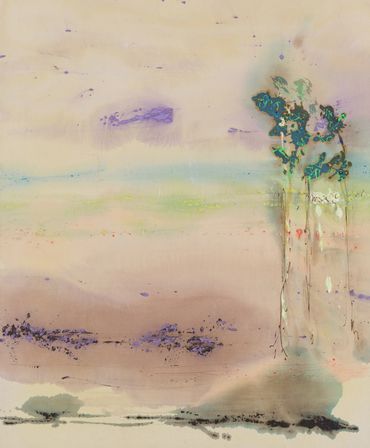
Often defined by his use of light with layered color, Milton Moss’s paintings were described by art critics as reminiscent of English Romantic painter William Turner, and the French artists Claude Monet and Jean-Baptiste-Camille Corot. Henri Matisse, who Moss met while studying art in Paris, was also among his key influences.
"There is a filmy effervescent feeling,” to his work, a critic for ArtNet wrote. In a 1966 preview of a new show by Moss, critic Jeanne Paris noted how his use of realism took cues from impressionism and surrealism, as well as his background as a violinist.
As a violinist, classical and jazz music were entwined with his art throughout his career, and lent a lyrical, and at times rhythmic quality created through brush stroke and in his use of wet layers of paint. “This,” one critic wrote, “creates canvases which can be read measure to measure.”
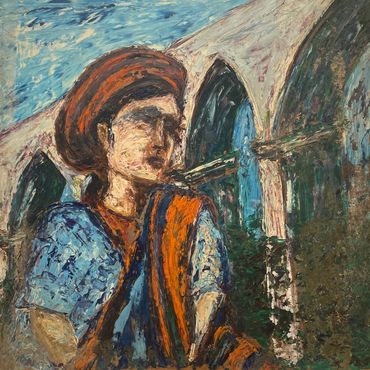
His work was also inspired by the places he lived and traveled, from European architecture and landscapes to the streets of San Miguel de Allende. In the early 1990s, Moss moved to Florida and opened Katem gallery, named after his youngest daughter, in the Miami Design District.
His work has been held in a private collection and has not been shown since his death in 1997. “The Long Return” at domicile is his posthumous debut, presented by his family in New York and Seattle.

COLLECTION

.jpg/:/cr=t:2.83%25,l:2.83%25,w:94.34%25,h:94.34%25/rs=w:370,cg:true,m)


.jpg/:/cr=t:2.83%25,l:2.83%25,w:94.34%25,h:94.34%25/rs=w:370,cg:true,m)